This past May, having just wrapped up my previous startup, I was invited by the Wei Chuan Dragons to briefly serve as their Marketing Director. Looking back, it was probably the best gift from above for someone who loves baseball and has worked in the internet industry.
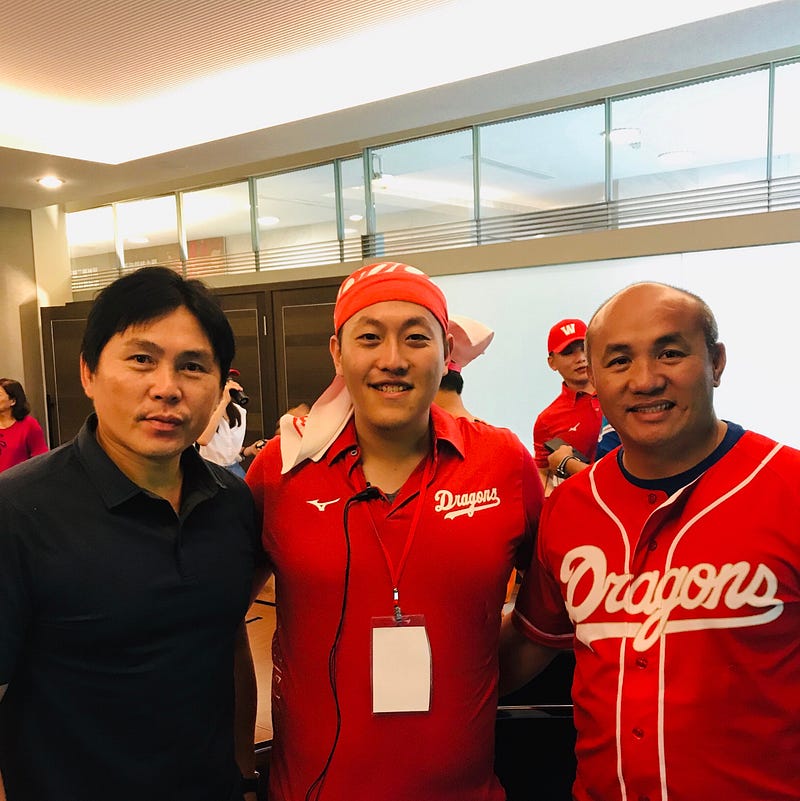
Both Taishan and Manager Ye are idols I’ve watched since childhood.
That said, it was still an incredibly challenging job.
First, from their dissolution in 1999 to their miraculous return to the CPBL (Chinese Professional Baseball League) in 2019, the Wei Chuan Dragons had disappeared from professional baseball for a full twenty years. Middle schoolers who were watching games back then are probably fathers of two by now. For those fans, the Dragons’ return was like the girlfriend Kelly in the movie Cast Away — first believing Chuck had died in the plane crash, then watching him walk back home four years later. It was a bittersweet mix of nostalgia and not knowing quite how to react. Furthermore, all the rumors and speculation over the years had left fans with plenty of questions about the new team. The new organization had a significant responsibility to provide a “face-to-face conversation” and give these longtime and new fans proper answers.
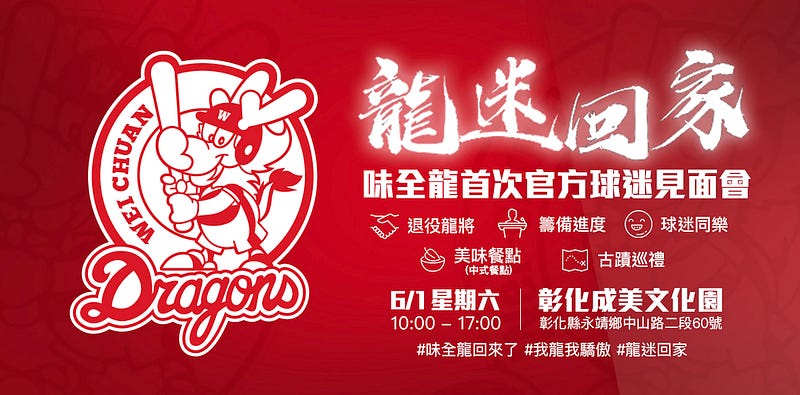
Dragon Fans Come Home: The Wei Chuan Dragons’ first official fan meet-and-greet.
Therefore, the first task I was given upon joining was to organize a physical “fan meet-and-greet with real communication.” This event wasn’t just the team’s first “official event” since their return after 20 years — it was also the new organization’s first “major formal event” upon returning to the professional baseball stage. The organization set the following three key requirements: 1. To thank the fans for their support, this would be a free-admission fan event. | 2. Since this was the first time, we needed precise control over resource allocation efficiency. | 3. New team, new look — we wanted fans to feel a sense of innovation and difference.
Due to the explosion of online information, “thousands register, nobody shows up” is a common phenomenon for free events. (YouTube screenshot)
Considering all three requirements, anyone with some experience in the internet industry understands just how enormous a challenge it is to precisely manage resource allocation for a free event. So the moment we received the task, our team established one crucial guiding principle: “This event needs to give us precise control over fan attendance.”
Next, we began dividing the entire event planning into the following five stages:

First, identify your target, then figure out how to reach them. (Photo Credit: https://pse.is/J7RN9)
Registration: Understanding fan demographics to define our base audience.
In the world of internet marketing, knowing who you’re speaking to is the top priority. That’s why we define a “Target Audience” to ensure our resources are invested in the right things.
One week before announcing the event, we changed the long-idle “Action Button” on the team’s Facebook fan page to “Register,” linking it to our simple registration form so fans could leave their basic information. This gave us our first batch of target audience members to invite to the event.
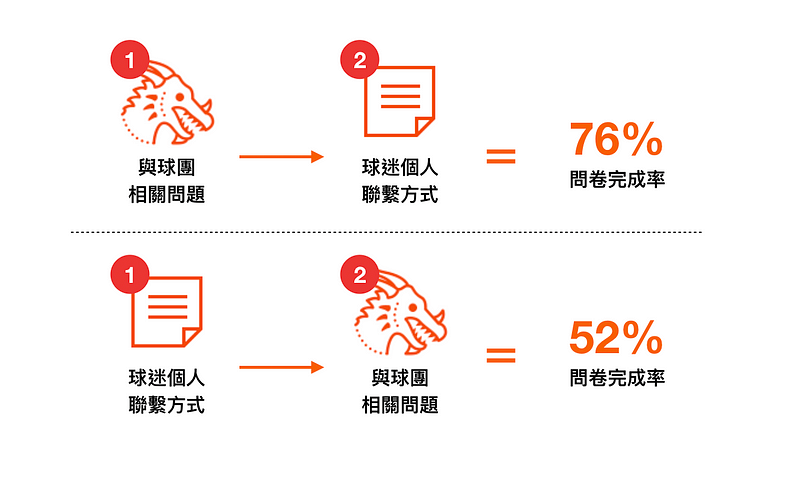
When fans aren’t yet familiar with the team, placing team-related questions at the beginning effectively increases form completion rates.
Considering that 50% of our fan base was aged 35 and above, we designed the form to be extremely simple — fans only needed to leave their name, phone number, and email, then answer some basic questions about the Wei Chuan Dragons to complete the registration. The entire process took less than 1 minute. During the first 24 hours, we also conducted A/B Testing on incoming fans to test different audience segments. We discovered that the survey flow of “asking Wei Chuan Dragons-related questions first, then personal information” resulted in only a 24% drop-off rate — meaning only 24% of people closed the form without completing it.
After confirming this flow, in less than a week, we collected nearly 10,000 fan registration entries.
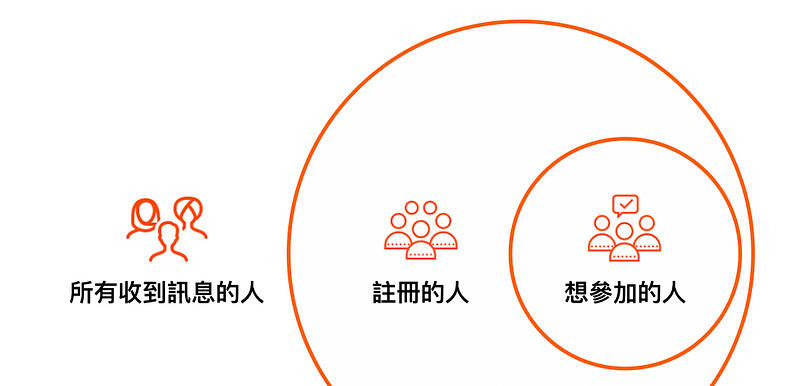
Segment all fans who received messages, then deliver different content to different groups.
Sign-up: Deliberately split into two steps to deliver targeted messaging.
Many people asked: “Does completing registration also mean event sign-up is done?” If not, why split it into two stages?
Since we couldn’t confirm whether fans had provided their “primary email address” during the “registration” phase as a communication channel, the second-stage sign-up process was a critical step. It helped us verify whether “this email address is a suitable channel for communicating with the fan.”
We used the “Yet Another Mail Merge” add-on in Google Sheets to send fans notification emails about converting “from registration to event sign-up,” while simultaneously tracking their email open rates and sign-up status for further analysis.
The initial attempts were definitely painful. Due to the mass email sending, our first 500 emails had an abysmal 2.8% open rate — only 14 out of 500 emails were actually opened. So we added more data fields in Google Sheets using information fans had provided during registration, such as their “preferred nickname,” “favorite player,” and “the year they started following the Wei Chuan Dragons.”
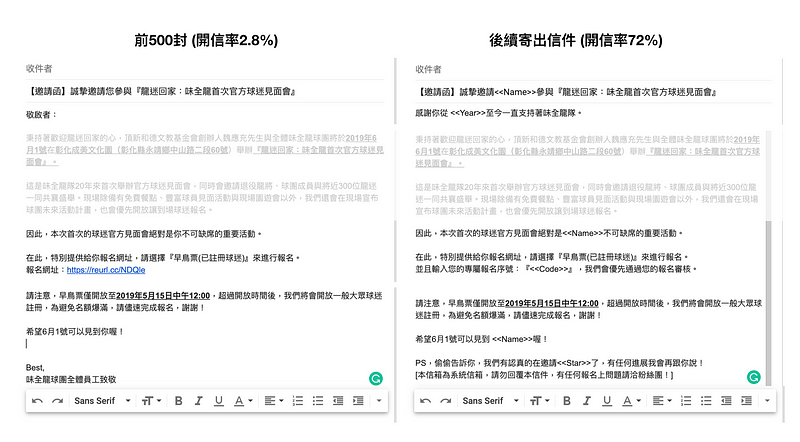
In addition to adding each fan’s name to the email subject line, we also used phrases like “Thank you for supporting the Wei Chuan Dragons since <<year user started following>>” and “We’re inviting <<user’s favorite player>> to attend!” to boost conversion rates.
Through two consecutive days of customizing “email subject lines” and “email content,” we successfully pushed the open rate to an astonishing 72%. With even more personalized content, we managed to raise the sign-up link click rate to nearly 100%.
For our audience, email communication turned out to be an effective method. We rushed to send out nearly 10,000 emails within three days and began waiting for fans to sign up over the weekend.

Reviewing registrations based on fan-provided information. (Photo Credit: https://pse.is/G7H3A)
Verification: Reviewing eligibility based on audience-provided data.
To track the sign-up status of fans who received emails, we included a unique “passcode” in every email. When fans entered this passcode during sign-up, we could cross-reference it with the fan registration data already collected in our backend to track each email recipient’s sign-up status for the event.
Considering both “entry efficiency” and “the ability to verify fan registration data,” we chose “Accupass” (a popular Taiwanese event registration platform) as our registration website for this inaugural event.
Unfortunately, our plan to open registration only to “registered fans” was disrupted when our system accidentally sent out an invalid short URL, forcing us to publicly release the Accupass registration page on the fan page ahead of schedule.
On the first day of open registration, we received nearly 6,000 sign-up entries, and the numbers kept climbing as the weekend approached. Fortunately, because we had implemented the “passcode” verification method, we quickly filtered out approximately 4,000 duplicate registrations and unregistered sign-ups during the first weekend.
After using the “passcode” to verify sign-ups, we approved over 2,000 fans within a single weekend. The next step was to begin streamlining our resource allocation.

After segmenting fans, reach out through the contact methods they provided, directing outcomes toward either “watching the livestream” or “attending in person.”
Outreach: Segmented follow-up communication using fan-provided data.
Using the sign-up data we had collected alongside our registration database, we divided the signed-up fans into three groups: “Registered and signed up,” “Registered but not signed up,” and “Signed up but not registered.”
First, for the “Signed up but not registered” group, we used Accupass’s built-in rejection notification feature, including a “Registration” form link. We informed them that by registering now, they would have priority access to future event notifications — this immediately boosted our registration count past the 10,000-person milestone.
Next, for both the “Registered but not signed up” and “Signed up but not registered” groups, we classified them as “interested but unable to attend in person.” We provided them with the livestream link and instructions for our collaboration with the “17 Live” streaming platform, allowing these fans to participate online and interact with us simultaneously.
Finally, for the “Registered and signed up” fans, since the numbers truly exceeded the event venue’s capacity, and to more precisely allocate resources to serve fans who would actually show up, we established one rule: “If a fan doesn’t show up after registering, or inflates the number of guests they’re bringing, they will not be invited to future Wei Chuan Dragons official events.”
Beyond using “Yet Another Mail Merge” to send more customized, segmented pre-event notifications based on their sign-up details (number of guests, transportation method, dietary preferences, etc.), we also used photo albums on the fan page and star player video messages to encourage fans who had successfully registered to confirm their attendance numbers with us.
Through “Yet Another Mail Merge” open-rate tracking, we successfully pushed the pre-event notification email open rate above 93%, and received replies from 72% of registered fans. In the final days, we supplemented with SMS (text message) notifications for those who hadn’t opened their emails, successfully gaining precise control over the expected attendance and dietary preferences for the event.
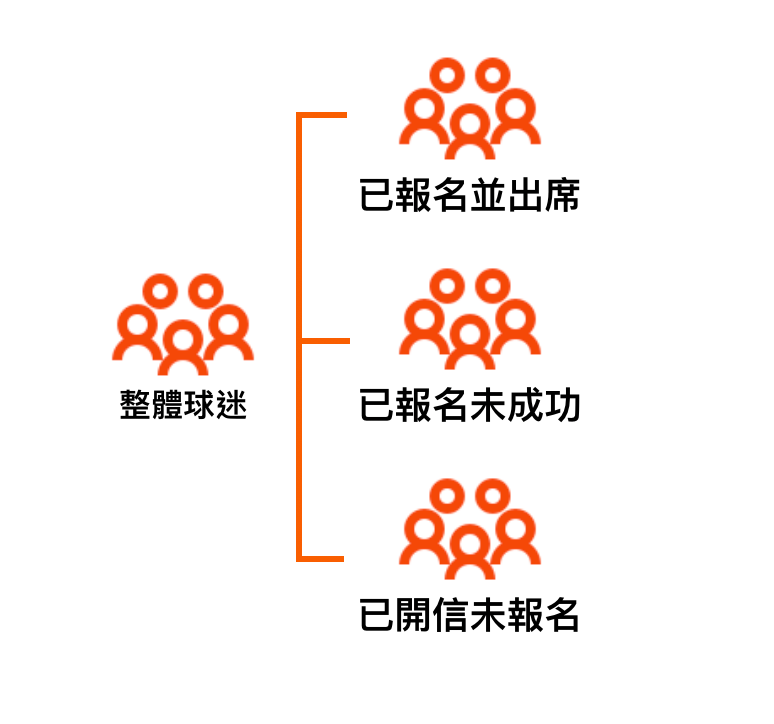
Tagging fans with different statuses helps assess their likely engagement with future events.
Feedback: Tagging fans for future marketing use.
On the day of the event, we asked the student workers at the entrance to carefully verify whether the actual number of attendees matched the registered count when scanning fans’ entry QR codes. In the end, based on reports from the on-site staff, registration accuracy reached 95%, and we achieved an extraordinary 80% show-up rate among those who registered.
For a free event, an 80% attendance rate is an absolutely incredible number.
At the same time, because we had segmented fans based on their provided information during registration, we had much more precise control over parking space allocation, the amount of food prepared at vendor booths, and fan entry flow and timing. In the post-event survey sent to attendees, we received 98% positive feedback, with 72% of respondents specifically mentioning that the event’s organizational precision and management left them satisfied — this was arguably the best takeaway from the entire event.
More importantly, because we had previously verified registration data, from our list of over 10,000 fans, we were able to tag the following segments: “Registered but didn’t open email: need to check if contact information has been updated,” “Opened email but didn’t sign up: need continued outreach to gauge willingness to participate,” “Signed up but wasn’t approved: willing to participate but couldn’t register successfully,” and “Signed up and attended: highly engaged and cooperative fans.” These tags can be used for even more precise segmented marketing when organizing future offline events.

In the future, we hope to use more precise audience segmentation and automation to reduce the need for manual labor.
Since this was the first time organizing such a large-scale event, behind the scenes, it was actually the result of many colleagues’ painstaking, meticulous work — replying to messages one by one, verifying data, and confirming details. We hope that in the future, as the organization adopts “new technology” and “new perspectives,” we can eliminate more unnecessary manual tasks. We welcome any vendors with relevant experience and solutions to help us make the entire process smarter and better.