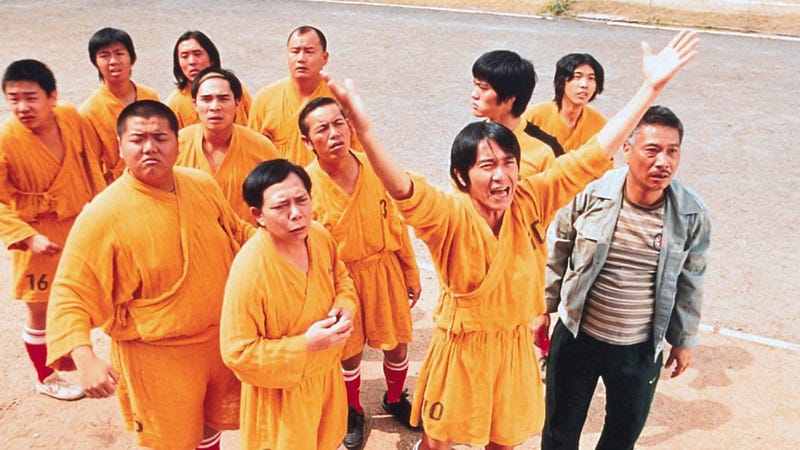
There’s always a reason why certain people come together. (Still from the movie Shaolin Soccer)
As social creatures, you’ve undoubtedly been part of all kinds of groups.
You might have a group of friends who are never on time, drinking buddies who love dirty jokes, gambling pals who throw money around, a no-nonsense family, and an incredibly cohesive team at work. Every human group inevitably develops its own unique behaviors, atmosphere, and rules — this is what we call “team culture.”
For early-stage startup teams, because the headcount is small, the work is varied, and everyone is together day in and day out, all sorts of team cultures tend to form particularly easily at this stage, shaping the company’s overall culture for the future. For example, Facebook encouraging employees to challenge their superiors, Airbnb’s office interaction spaces, and Line’s asynchronous communication are all unique team cultures that were cultivated from the early days.
Everyone says that a team leader’s most important responsibility is “building a good team culture.” But how exactly is a good “culture” cultivated?
Team Culture (Culture of Shared Principles): Refers to the subconscious culture formed by team members in the process of working together to achieve common goals.

For example: Whenever our team has something particularly important to remember, we all dance together.
I remember back in middle and high school, campuses were always plastered with “school mottos” and “educational mission statements” — these are actually the most obvious forms of team culture. Today, most people have long forgotten their school mottos, yet they probably still remember certain special traditions, like “throwing the birthday person into the lotus pond” or “tossing all your textbooks off the corridor balcony right after final exams.” (Reference: If you really can’t remember, here’s a list of university mottos)
Both are forms of team culture defined by a group, yet some leave zero impression while others stay with you forever, even long after you’ve left the group. This is the biggest difference between varying degrees of team culture. A successful team culture shouldn’t be a superficial slogan — it should be a deeper-level “subconscious culture” that team members will always remember.
In everyday experience, the most commonly seen superficial team cultures are usually established through the following two methods:
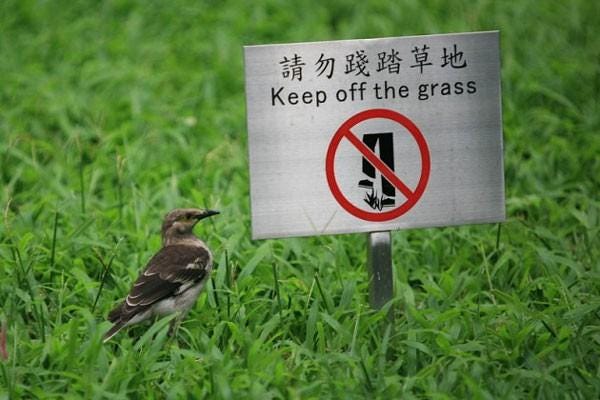
This bird is bad. Really bad.
Method One: Write the team culture on the wall and make everyone memorize it.
Text written on walls is called rules; text you’re required to memorize is called slogans. These are indeed useful methods in some ways. For example, putting up a “Please Keep Off the Grass” sign in front of a lawn does effectively deter some “unconscious” individuals who were planning to hop over the fence. But the moment team members are in a place where they can’t see the text on the wall or recite the slogans, and they need to make real-time decisions, this kind of superficial team culture naturally gets ignored.
Presenting the team culture you want to establish through posters, graffiti, or slogans is the fastest way to make people feel like “you’re building team culture.” But at critical moments, it often fails to influence the fundamental thinking of team members when making decisions, and it certainly can’t cultivate a subconscious team culture. (Reference: HowFun / “Soldiers, it’s time for the battlefield!”)

Does your company also use punishment to regulate employee behavior?
Method Two: Build team culture through rewards and punishments.
For children under five years old, “reward and punishment experiences” can indeed change their thinking and, through past experiences, influence how they handle specific situations in the future. But this doesn’t work for team members over five years old. We can use this model to quickly change team members’ behavior in the short term. However, once these rewards and punishments gradually make team members tired and numb, if you can’t escalate the incentives, all the unwanted behaviors will resurface — until someone can’t take it anymore and leaves.
When a team leader needs to quickly establish a strict surface-level system, the reward-and-punishment model can rapidly show results. But this model often hits a dead end due to “team members’ fatigue with rewards and punishments” and “the inability to amplify the impact of rewards and punishments.” It fundamentally cannot change team members’ mindset about team culture.
Therefore, building a deeper-level team culture is the best approach to solving the various problems a team faces and shaping a healthy team working style.

The subconscious culture that emerged from our team’s brainstorming sessions… I think.
So, how do we shape the right team culture for our team?
When we first started defining our team culture, we referenced many articles and experiences shared by predecessors, but we could never find a method for designing team culture. Until one day, I happened to come across a book by the architect Sou Fujimoto called “When Architecture Is Born” (Kenchiku ga Umareru Toki), which discussed the concept of “weak architecture”: “The designer should reduce the amount of ‘designing,’ letting users define how to use the space themselves, while the designer only prevents undesirable usage patterns.” That’s when we had our initial idea:
“Suppress undesirable behaviors, and let the team naturally develop its own culture.”
From then on, we began building our own team culture using this “subtraction” approach.
In simple terms, after initially mapping out our thoughts on team culture, we didn’t create specific slogans, rewards, or punishment rules. Instead, we let everyone organically develop and shape their own team culture. Team culture is like a tree — as long as the team atmosphere is harmonious, it will naturally grow and sprout. Then the team leader prunes and maintains it to shape it into the ideal team culture. Although, admittedly, this is anything but simple.
Step One: Suppress undesirable behaviors — decide what needs to be trimmed.
As a team leader, when defining team culture, there are definitely many “things you don’t want to happen in the team.” For example: we don’t want team members to be late for meetings. Therefore, whenever someone is late to a scheduled meeting, the team must unanimously not allow that person to join the meeting. They must make up for what they missed on their own — by reviewing meeting notes, asking colleagues about assigned tasks — making them feel that “not being on time for a meeting is just too much trouble,” thereby changing their behavior.
If you let someone who’s five minutes late join the meeting, it tells team members that “being five minutes late is within everyone’s tolerance range.” Every time you say the meeting starts at 1:00, everyone’s mental clock will shift to 1:05, and then someone will show up at 1:15…
Do you also have a group of friends who “always starts showing up 30 minutes after the agreed time”? Make no mistake — this kind of “team culture” was created by all of you.
Step Two: Reinforce desirable behaviors — personally support what you want to maintain.
As a team leader, when the team naturally exhibits behaviors that you believe are beneficial to shaping team culture, you must step forward and personally participate. For example: someone on the team organizes a weekend hiking trip. If you believe this kind of activity contributes to team bonding and a positive atmosphere, even if you’re not a sporty person, you should personally participate. Over time, this will gradually transform into the team’s culture, even without writing “We love hiking” on the wall.
A team leader’s personality, to a certain extent, represents the team’s personality. If you want team members to have a “pursuit of perfection” mindset, you not only need to lead by example — when you see a colleague staying late to “pursue perfection,” you should stay with them and help share the workload.
The cardinal sin of building team culture is: saying one thing but doing another. If you want your team to be proactive, you must be even more proactive. If you want your team to be responsible, you must bear even greater responsibility. Sometimes, team culture is more a reflection of the leader’s own character.
Step Three: Initiate desirable behaviors — create what you want to see.
I remember one afternoon, a colleague brought soup that her family had prepared for her, heated it up on the office stove, and shared it with everyone. Normally, we’d all go out in small groups for lunch, but that day the atmosphere of everyone eating together in the office was especially warm. I thought it was wonderful.
So starting the following week, I began shopping at the nearby supermarket and, roughly every other day, cooked some dishes to share with everyone. I’m not someone who typically cooks, and my culinary skills aren’t anything special. But as more colleagues started staying in the office for lunch every few days, gradually more team members began cooking their own lunches and sharing meals together. Over time, cooking and eating lunch together in the office every day naturally became part of the company’s unique culture.
If you want meeting notes to be completed on the same day as the meeting, you should lead by example and complete the notes for every meeting you attend. If you want people to share what’s on their mind, you should be the first to open up and share your thoughts one day. We can’t dictate exactly what a team’s culture should look like, but if you want to create “that kind of” team culture, you need to lead by example, fire the first shot, and consistently nurture it into a shared subconscious culture.

Our office kitchen is always packed at lunchtime.
If you accidentally cultivate some “bad culture” before you’ve figured out what your team culture should look like, the cost and effort of “changing culture” is far greater than “building culture” from scratch. The price is either people leaving or a ruined team atmosphere. Since established culture is hard to undo, it’s especially important for team leaders to plan their ideal team culture from the very beginning.
Similarly, a company’s “corporate culture” also affects countless employees’ decisions to stay or leave. Because of the long hours spent together daily, team culture will, over time, gradually push out everyone whose vibe doesn’t align. While establishing team culture doesn’t guarantee great achievements, good team culture always retains the best talent. As the saying goes, “birds of a feather flock together.” Since we have to work eight hours a day regardless, everyone naturally wants to spend that third of their day working with people they get along with.
So, will you start evaluating “team culture” as a key factor during your next job interview?
We are Addweup, a team dedicated to solving the problem of leftover foreign currency after traveling, and we’ll be launching our services across Southeast Asia starting in the second half of 2018. Our team values freedom and responsibility, with great work flexibility and exciting challenges. If you share our vision and like our team culture, we’re currently looking for Python backend engineers and interns. Feel free to check out our job openings or send us your resume.

We welcome partners who love challenges and value flexibility and freedom to join us.